Despite a frantic schedule and the notorious Johannesburg traffic which delayed the arrival of supporting artists, front of house engineer for The Script, Stephen Pattison kindly took the time to talk to Pro-Systems Africa News ahead of the show at The Sun Arena in Pretoria on 4 May.
Pattison’s years of experience, passion for music and deep understanding of his craft, together with his charming wit and easy-going demeanour made for a truly memorable interview.
How did you first get involved in the events industry?
I started my career as a session musician, playing the guitar for various bands. Following that, I got into a bit of studio engineering as I was fortunate enough to have a friend who was a producer. I asked him to call on me when he didn’t need a guitar player so that I could sit in the studio and learn. That is basically how I came to be a studio engineer, I then decided that I didn’t necessarily want to sit in a room for the rest of my life, and wanted to get involved in live events. I got in touch with a company called Adlib Audio, based in Liverpool, where I started my career mixing live sound.
Is there a specific gig that stands out as your favourite?
I attended what I consider to be one of my favourite concerts as a punter some years ago while in America, where I got to see AC/DC performing live at the Long Beach Arena in California. I was on holiday in the USA at the time and happened to hear that AC/DC was praying. I knew the front of house engineer at Long Beach Arena, so I phoned him up and asked him to give me a pass. It was a great show, and I had a really fantastic time.
Who have you most enjoyed working with during your career?
I have been quite lucky, as most of the artists that f have worked with have been fantastic. I used to work with Amy Winehouse – and she was just amazing. She is one of those vocalists who opens her mouth to sing, and everybody is instantly blown away. Sharleen Spiteri from Texas is another amazing singer with whom I have really enjoyed working. These are acts where you can just push the faders, sit back and enjoy – because they sound great without much help.
I have also enjoyed working with The Script. The boys have written some amazing songs, and they perform some great tunes with fantastic melodies. They are all genuinely nice guys and are very professional, If, for example, I need them to perform a specific song or a couple of songs for a sound check, they are always willing to work with me and remain professional in everything that they do.
What would you say is the worst experience you have had at front of house?
It is very rare to have a serious technical problem on a professional production. However, when we were in Belgium for the tour, the power failed -which was interesting when performing live for a crowd of 16 000 people.
Two independent power sources service the venue, so power supply didn’t seem likely to pose any problems. During the supporting act, the first power source failed and at the lights, including the lighting desk, went down. We continued with the show, relying on the second power supply, but when boys from The Script came on, the second power supply also failed.
All of the instruments on stage and all of the technical equipment started freaking out – so we decided to stop the show until we were able to find out what was going on. The funniest moment was when our monitor technician, Mark, was trying to tell the band to go off stage, but everything kept switching on and off, and he kept breaking up – so the guys had no idea what was going on. Eventually, we resorted to hand signals get them off the stage.
Which sound desk are you working on for your current tour with The Script?
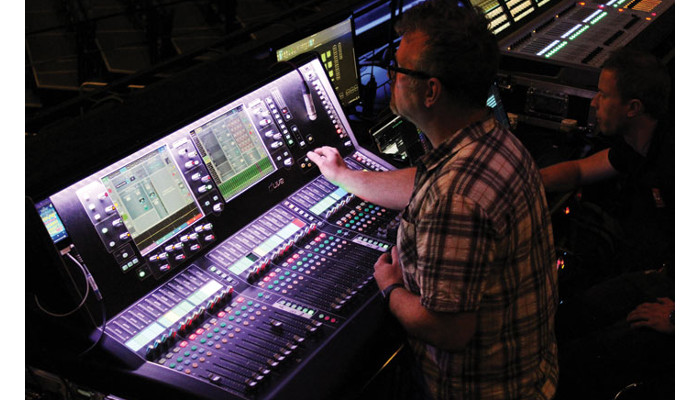
The Allen&Heath DLive console is my personal choice of sound desk for this show, and for many other shows. The Allen&Heath DLive S7000 has everything that I need in a desk, especially when on tour. The console is easy to use, does not cost the earth and you can get it in most Countries and venues. Most importantly, it is super reliable and always sounds great.
With the broad range of sound desks available on the market, why is the Allen&Heath DLive your desk of choice?
I can always rely on the Allen&Heath DLive 57000 to sound good and, most importantly, to be reliable -which many desks nowadays aren’t. There have been some very high profile events where, despite the fact that the latest and greatest equipment is being used you can hear pops and bangs going on -which is a bit cringe-worthy. I’ve never had that happen on an Allen&Heath desk yet.
Another great feature of the desk is that it is highly flexible. I use Waves and Dante cards for recording and virtual sound check, and together this allows me to get a backup recording on certain shows. The comprehensive monitoring and set-up page makes everything very easy to set up, which is great in festival situations when you can simply point a recording truck in the direction of the superMADI card, and they can get whatever format they need. I don’t know what else you need from a desk.
Do you have a personal preference when it comes to PA systems?
There is not really a bad speaker box out there anymore – its all about the guys setting it up. If there is enough of it, it covers well and is set up correctly; any system can do a perfectly good job, no matter what brand you use.
That being said, some speaker boxes do deliver better than others in certain areas. Some are fuller, some fire really far- there is a wide variety of factors to consider. Over the years, and based on some of my recent tours, the L-Acoustic K1 is always up high on my list, and we have used both the K1 and K2s for our shows in Asia.
Another product worth mentioning is the relatively new Coda AiRAY -which I think is amazing. When you see the box, it’s difficult to take it seriously – but once you push the fader up – it just blows your mind.
We toured with a Coda AiRAY system on the European leg of The Script tour. Some of the venues booked included 25 000-seater arenas, while for other shows we played to no more than 4000 people. The Coda AiRAY was fantastic for the job because the box is small and light, weighing only 35Kg, making it very flexible. If I had a K1, it might have been an issue hanging arrays – because you are limited by the weight-bearing capacity of some of the smaller venues.
What, in your opinion, is the highlight of the current tour with The Script?
For me, the highlight of this tour is that every show is different. The guys make sure to do something novel for each venue booked. During the European leg of the tour, we had the luxury of taking all of our kit with us – including our own stages.
We used two stages for the European shows, and the boys would make their way around the venue – making sure to connect with everyone. The band has included an acoustic slot in the show where they go out into the audience. So, someone who is seated in a block somewhere at the back will suddenly look up and see the guys performing right up close. The idea is that everybody gets to be a part of the show, even if they have not managed to get the best seats in the house. I think this is something that sets The Script apart – they are really amenable to their fans.
The guys are very active on social media, and if kids hang around after the show hoping to meet them, they are always willing to take the time to sign autographs and chat with their fans. Mark is particularly good at letting fans know when they have left the venue on social media so as not to keep fans waiting in vain. Also, the guys invite different guests to perform with them which keeps things fresh and interesting. We found out the day before the show that we would have a guest choir performing at The Sun Arena.
Have you enjoyed working on the South African leg of the tour?
Working with Gearhouse and all of the local guys involved has been great. The venues and equipment are all well looked after and maintained, which means that everything works well. Set up was quite impressive, and the guys did a great job getting the PA set up this morning so that everything is tuned and ready to go in good time.
Do you have any advice for sound engineers that are starting in the field?
Yes, I would encourage the younger guys to go out and try different types of equipment and play with the gear that is available. Don’t assume that because something is the latest or most expensive technology that it is automatically the best there is. As a sound engineer, your most important tool is your ears – use them. If it sounds great – then it is great, no matter what badge is on the desk.
Also, don’t rely on everybody else to do things for you. Go to the stage and check that everything is in the right place. If something is making a noise, ask yourself if it is making the right noise. Check that you have the right microphone. Check if the microphone is in the right place. Make sure that your cable is run nice and neat, so that you can trace it if there is a fault. Work neat – which makes your life easy.